“I could see inside my own heart!” When an Ipswich mum suffered multiple heart attacks, the trial of 50 new ‘submarine-like’ probes, funded by the West Moreton Health Foundation, gave doctors the view they needed to save her life.
Ipswich local Belinda Hartas remembers quite clearly when a probe was sent through her arteries and into her heart. She remembers because she was awake.
During the Easter long weekend this year, the 44-year-old commercial real estate agent was unaware she had likely suffered several heart attacks, brushing her blackouts off as feeling unwell.
When she went to see her GP, he called for an ambulance to urgently take her to Ipswich Hospital.
“I remember getting into emergency, into the resuscitation room and I think I said something like, ‘I’m gonna go now,’ and then I went into cardiac arrest again. Twice,” Mrs Hartas said.
But fate had other plans in store for Belinda.
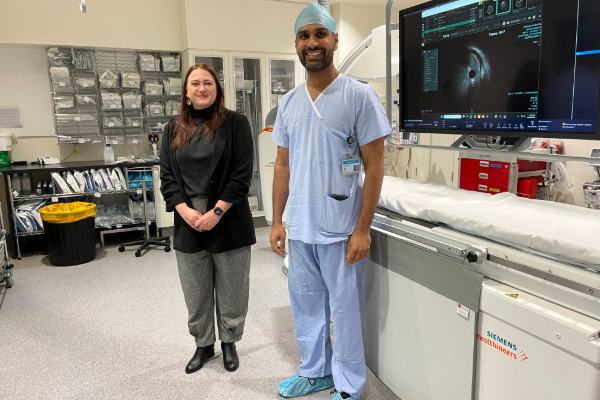
Belinda was to benefit from an intravascular ultrasound (IVUS) trial, which had been funded through the West Moreton Health Foundation’s Impact Funding model, following an application submitted by Dr Yohan Chacko, an Interventional Cardiologist at Ipswich Hospital.
“Research has shown using IVUS during coronary stent insertion improves patients’ outcomes after heart attacks. However, cardiology teams are often reluctant to get it off the shelf and use it on patients, predominantly due to lack of familiarity with the technology, and long setup times” Dr Chacko said.
“For Belinda, using IVUS helped make a diagnosis and treat a rare cause of heart attack, that would not have been otherwise suspected.”
What is intravascular ultrasound (IVUS)?
IVUS works through a tiny two-millimetre catheter threaded into the arm of the patient at the wrist, which doctors can use to guide an ultrasound probe along the patient’s arteries to their heart, watching for problems in real-time.
According to Dr Chacko it allows you to put a bigger stent and position it more precisely inside the artery.
“It’s like a submarine going through your blood vessels and heart, mapping the inside of your coronary artery, so we can see and diagnose exactly what’s going on,” Dr Chacko said.
In 2023, the average IVUS use rate during stenting procedures was just 9.3 per cent at Ipswich Hospital compared to 13 per cent in public hospitals across Queensland. Dr Chacko thinks it should be much higher.
An international study, grouping more than 15,000 patients found that using IVUS during stenting procedures cut deaths from heart problems by 45 per cent and dangerous stent clots by nearly half compared to standard imaging alone.
“We should be using it in 50 per cent or more of cases requiring stents because when used, it improves a whole range of outcomes, especially reducing recurrent heart attacks and death,” Dr Chacko said.
“The current IVUS technology we have available at Ipswich Hospital, gives very high-resolution images to look at heart arteries from the inside.”
Dr Chacko requested 50 IVUS probes through the West Moreton Health Foundation and carefully studied how long it took staff at Ipswich Hospital to learn to use it accurately, efficiently and confidently.
“We gained valuable insights into how fast the learning curve to use this valuable tool was. This study may help develop training protocols for IVUS Australia-wide,” he said.
“We’ll only use it if it’s deemed clinically necessary but we’re now at 36 per cent and rising – more than triple the pre-trial rate and among the highest in the state.
“Meanwhile, set up time is about three times as fast since the end of the trial.”
Using IVUS leads to better patient outcomes
For Belinda Hartas, the speed and willingness of Ipswich Hospital staff to use IVUS was lifesaving.
“For my family it was completely unexpected because I don’t get sick. I’d always thought of myself as a bit of a machine but suddenly something like this happens,” Mrs Hartas said.
“It’s changed me. There’s a bit more gratitude now for what we have in life.
“The West Moreton Health Foundation and the doctors who got this equipment have done an amazing service for the public. I’d encourage them to continue the work they’re doing because it saves lives and without them, I wouldn’t be here.”
Scott Young, CEO of West Moreton Health Foundation, said the charity was proud to partner with the health service and doctors to improve patient’s lives.
“Belinda’s story shows how quickly new technology can make a difference,” he said.
“Behind every piece of equipment we fund are real people and real families. I’d like to congratulate Doctor Chacko for advocating for this successful trial and equipment.”
Dr Chacko will present the results of the Ipswich Hospital’s IVUS trial, which ran from October 2024 to May 2025, at the Transcatheter Technologies conference in the United States in October, which is the country’s largest interventional cardiology meeting.